

Shell Shock: The Cruelty Inside Exotic Eggs
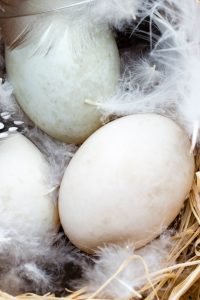
The duck eggs market is generally regarded as second only to the market for chicken eggs. They are a key ingredient in many Asian dishes, and the international popularity of this cuisine has led to a growing demand for duck eggs in North America and Europe. The global duck eggs market was valued at USD 100 million in 2023 and is expected to reach USD 150.36 million by 2030.[1]
Yet animal advocates have found that ducks raised for eggs routinely suffer amid squalid environments. One undercover investigation of a farm supplying duck eggs in 2022 exposed “extreme acts of animal cruelty and horrendous living conditions,” including workers killing ducks by swinging them around by their necks, ducks with injured limbs using their wings to drag themselves across excrement-covered barn floors, male ducks repeatedly mating with female ducks who were unable to move, and mice and pigeons in the ducks’ feed troughs. Meanwhile, with water and fresh air being among the duck’s most basic needs, the investigation found the birds had no access to water that would allow them to bathe, preen, and dip their heads and had no access to the outdoors.[2] Other investigations have revealed ducks confined to battery wire cages, much like those used by the chicken-egg industry, with two or three ducks crammed into each cage and barely enough space to move.[3] [4]
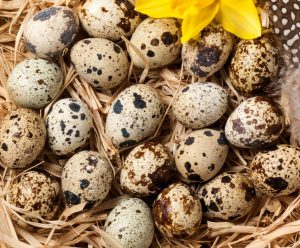
Quails are the smallest commonly farmed birds, sometimes weighing as little as 100 grams (about 3.5 ounces) when fully grown.[5] In nature, these ground-nesting birds can be found across North America, South America, Asia, Europe, Australia, and Africa.[6]
Quail hens reach maturity at 7 to 8 weeks old and will begin laying eggs. In commercial egg facilities, most of these birds will spend about 8 months in battery cages or overcrowded barns, after which they will be slaughtered.[7] The intensive confinement found in most quail egg facilities do not allow the birds to express their natural behaviors, often resulting in stress, boredom, and the development of abnormal behaviors such as feather pecking and pacing.[8]
“Witnessing such tiny, fragile birds being subjected to the callousness of overcrowded, filthy factory farm conditions was devastating,” said one investigator of a quail egg farm in the European Union. “The lack of care was palpable and widespread. I was stunned. How could anyone stand by and let this happen? How could these little birds be so shamelessly and extensively abused?”[9]
The high cost of quail eggs, relative to other bird eggs, has helped keep them a niche food, although demand is growing. Sales of quail eggs in the United States are forecast to go from USD 81.93 million in 2025 to USD 131.57 million in 2033.[10] The global market, meanwhile, is projected to increase by about 30 percent during this same period, from USD 2.13 billion to USD 3.04 billion.[11] Countries dominating the production of quail eggs include China, Thailand, Indonesia, Bangladesh, the Philippines, Brazil, and Russia.[12]

When most people think of humans consuming fish eggs they think of caviar, a term that traditionally only applied to the eggs (or “roe”) of sturgeons, although eggs from salmon, carp, cod, whitefish, and other fishes are also popular.[13]
Sturgeons are the largest freshwater fishes, and they are long-living and ancient—in fact, they coexisted with dinosaurs 200 million years ago.[14] They have evolved a mouth that is unique among other fishes as it is an extendable tube they use to suck up food items from the bottom of rivers and lakes.[15] Sturgeons are considered one of the most imperiled animals, with 25 of the 27 sturgeon species being listed by the International Union for the Conservation of Nature as at risk of extinction.[16] One of the reasons for them being threatened is how much they are exploited for their eggs, and this—coupled with sturgeons taking 7–10 years to produce these eggs[17]—has given rise to sturgeon farming.
In the commercial caviar industry, female sturgeons are raised in tanks and their eggs may be “harvested” in a number of ways. Traditionally, the fishes are killed before their eggs are removed, but no-kill methods have been developed, such as “milking” the fish of their eggs[18]; another is to perform a Caesarean section—an open laparotomy in which an incision of about 3 to 5½ inches is cut into the fish’s abdomen so that the ovulated eggs can be extracted; she is then sewn up.[19] While no-kill methods are marketed as “sustainable” and “cruelty-free,” they only serve to prolong the animal’s suffering and exploit them for as long as possible. Nations around the world profit from this exploitation. China, for example, is the largest caviar exporter with 168 tons annually, followed by the United States (76 tons), Italy (51.8 tons), France (31.8 tons), and Germany (22.7 tons).[20]
An undercover investigation carried out on an aquaculture facility in Canada revealed fishes being repeatedly stabbed in the abdomens to check egg maturity, struggling with cruel physical deformities, and intentionally starved for weeks to supposedly improve the taste of their eggs. Moreover, the investigator witnessed fishes living together in cramped, barren tanks; fishes thrown onto ice and freezing to death; and one 30-year-old sturgeon who had been kept alive so her eggs could be regularly cut out of her ovaries to produce other sturgeons.[21]
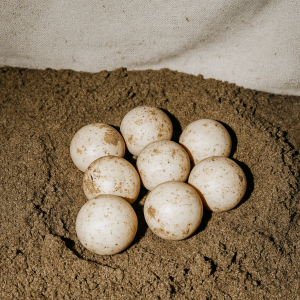
The eggs of sea turtles have become a popular though illicit trade among parts of Africa, Asia, the Caribbean, Central America, Mexico, and the United States, where all seven of these reptile species are listed as threatened or endangered.[22] Although sea turtle eggs have been consumed by coastal communities for hundreds of years, there is a growing demand for them around the world.[23]
Poachers hunt for eggs on beaches, where pregnant female sea turtles return to where they hatched and use their back flippers to dig a nest in the sand. After she has dug the nest and laid up to 100 eggs—a process that may take three hours—she will slowly drag herself back to the ocean and the eggs will incubate for about 60 days. The temperature of the sand helps determine the genders of the baby sea turtles: warm sand produces more females, and cool sand produces more males.[24] Ideally, the babies hatch and navigate their way to the ocean.
The collection of turtle eggs has been a major contributor to the decline in sea turtle populations.[25] This has led to conservation efforts around the world, with volunteers scanning beaches for trails in the sand left by mother sea turtles, tracing them to new nests, and relocating eggs to a hatchery before poachers find them. Thankfully, it appears that as of 2025, the decline in sea turtles may be reversing.[26]

Consumers in the Global North may be familiar with balut eggs because they have been featured on reality shows such as Survivor and Fear Factor, where television producers have used them as a challenge food that contestants must consume before advancing to the next level.[27] These are fertilized duck eggs that are considered a delicacy in many parts of Southeast Asia, often sold as a street snack.[28] They have been incubated until the embryo is really neither egg nor flesh; the embyro is then boiled alive.
The eggs are especially popular in the Philippines, where 87 percent of duck egg production is devoted to balut, amounting to an estimated 30,000 metric tonnes of eggs.[29] The city of Pateros, just outside Manila, is considered the balut capital of the world, and there the industry often relies on the old-school approach to creating these culinary cruelties: non-ventilated rooms filled with light bulbs simmer at more than 100 degrees F (38 degrees C), allowing the duck embryos to develop inside their egg shells for 16 to 18 days (ducklings normally hatch at about 27 days). A small operation can produce 40,000 balut eggs a week.[30]
Margaret Magat, who has written extensively about her Filipino culture, did an in-depth survey of balut consumers and found that most of them season the yolk, embryo, and albumen with salt. She thinks this may have as much to do with a guilty conscience as taste, however. “Many of my informants expressed strong feelings of disgust at seeing the embryo or catching a glimpse of the developed little chick,” Magat writes. “After studying the survey responses, I believe that the feelings of revulsion experienced by many at the sight of the fetus may be due to the idea of ingesting something that is clearly on the verge of being born.”[31] She suggests that the salt may be used subconsciously as a kind of purifying agent, “to cleanse the balut eater from the impure action of eating and therefore ending the life of the baby chick. I speculate that if this is the case, the sprinkling of salt may be for the balut eater a way of atoning for the ‘sin’ of ending another’s life for the sake of continuing his/her own. The notion that a life must be ended to ensure that others may live could be applied here, with salt acting as an offering to the sacrificed life.”[32]
Balut production has become popular in California as well. In 2024, a balut dealer in the city of Brea, near Los Angeles, made an error in production and called a duck sanctuary to say she had hundreds of ducks who were about to emerge from their eggs. Although nearly 400 ducks had hatched by the time the sanctuary could get to them, the dealer hadn’t given the birds any food or water, and only 120 ducks survived.[33]
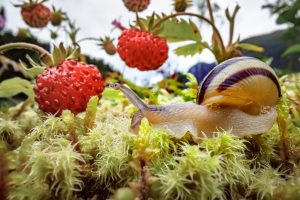
In their quest to find new delicacies, food producers turned to the eggs of snails. Also known as “white caviar,” eggs of the Cornu aspersum (European garden snail) species are round, with a milky white color, and measure 3–6 mm in diameter.[34] Snail caviar has become a big business in Europe—especially France and Poland[35]—where snail farming, or heliciculture, is a niche but lucrative practice.[36]
Snails may take two or three years to produce eggs, laying about 50 to 100 eggs each year. Eggs are removed from the dirt individually by hand, often with tweezers.[37] To speed things up, some producers feed their farmed snails a diet based on cereals, instead of the leaves snails naturally eat, which reduces their maturation time to about eight months.[38]
Snails may be small but farming them and taking their eggs is still a form of animal exploitation. Moreover, snails raised for their eggs are confined and are denied the freedom to travel where they wish.

An octopus mother will either lay tens of thousands of tiny eggs or about 100 larger ones, depending on her species. Either way, she is a fiercely protective parent and will spend her remaining days brooding and guarding the eggs—taking no nourishment herself—until they hatch, which can take months. As a result, the mother octopus almost always dies afterward.[39] Scientists even found a female of one deep-sea octopus species, Graneledone boreopacifica, who brooded her eggs for 53 months—that’s nearly four and a half years, the longest known brooding period of any animal. She didn’t eat the entire time and died soon after her eggs hatched.[40]
Octopus eggs are consumed as a homemade cuisine in Greece, though not as a commercial product,[41] and they are considered a delicacy in Japan, where they are known as “tako tamago” and sometimes feature in sushi dishes.[42] (There is another dish called “tako tamago,” which is a baby octopus stuffed with a quail egg and served on a stick as street food.[43]) The “egg” used in sushi dishes is actually a large, milky sac filled with eggs that resemble translucent teardrops.[44]
As we discuss in our page on octopus farming, octopuses have short lifespans ranging from six months to five years and only reproduce once. Both the male and the female die soon after the reproduction cycle is complete, making it especially tragic—and unsustainable—that people would steal and eat their eggs.

The eggs of black-headed gulls (Chroicocephalus ridibundus) are considered a delicacy in England, where every spring the government’s wildlife “conservation” group Natural England issues licenses allowing people to take thousands of these eggs from ground nests and sell them to posh restaurants, wholesalers, and food markets for human consumption.[45]
Black-headed gulls will often lay more eggs to supplement those lost to humans or other predators. Yet this comes at a metabolic cost to these birds, as they must eat more to lay additional eggs. Not only are the extra eggs smaller, but the endogenous proteins needed to form eggs come from the gull’s pectoral muscles, and depletion of these muscles reduces flight performance, foraging efficiency, and predator avoidance.[46]
Jeff Knott, director of policy for the Royal Society for the Protection of Birds, believes it’s time to end the issuing of licenses to steal gull eggs. “With many of our seabird species under increasing pressure from climate change, food availability and bird flu, the collecting of black-headed gull eggs for food is unsustainable, unhelpful and should stop,” he said.[47]
The reality is that humans will eat the eggs of just about anyone, including countless animals not mentioned here; indeed, it would take a much larger work to properly cover this topic. What is clear is that humanity has been stealing and eating the eggs of birds, fishes, reptiles, mollusks, amphibians, and insects for thousands of years. Sometimes this is for survival, but too often it is because of trivial motivations, including taste, tradition, scarcity, or ignorance (such as believing the eggs are aphrodisiacs). Whatever the reason, animals always pay the price. Eating a fertilized egg, for example, not only denies life to a complete organism but can, in the case of some species, contribute to their extinction. Moreover, the female and male animals farmed for their eggs suffer the abusive conditions and treatment that are inherent in exploitation.